How to move a stalled consortium decision into an owned next test.
A practical way to turn distributed evidence, stakeholder disagreement, and uncertain end states into a responsible move that someone can own.

Brian GoodmanFounder, BPG Labs · 15 September 2026 · 8 min read
A consortium can leave a productive workshop with a better understanding of the issue and still be no closer to action.
That does not necessarily mean the group needs more ideas. It often means the decision itself is still too diffuse: the evidence is distributed, stakeholders are carrying different definitions of success, important constraints have not been made visible, and no one owns the next test.
Define the decision before designing the solution.
Start with the decision that must become possible—not a broad topic such as “improve collaboration” or “scale the initiative.”
A useful decision boundary identifies:
- what must be decided;
- who must own or act on it;
- what would count as enough evidence for the next move;
- what remains outside the present decision; and
- when delay becomes consequential.
This keeps the work focused without pretending the wider system is simple.
Build the shared picture from distributed evidence.
In multi-stakeholder work, the relevant picture rarely sits in one report or with one team. It is spread across users, implementers, funders, policy actors, technical specialists, delivery partners, founders, investors, and affected communities.
The point of a stakeholder and evidence map is not to make every perspective equal or every claim true. It is to show who holds relevant experience or authority, where incentives or definitions conflict, which perspectives are missing, and which uncertainties could change the decision.
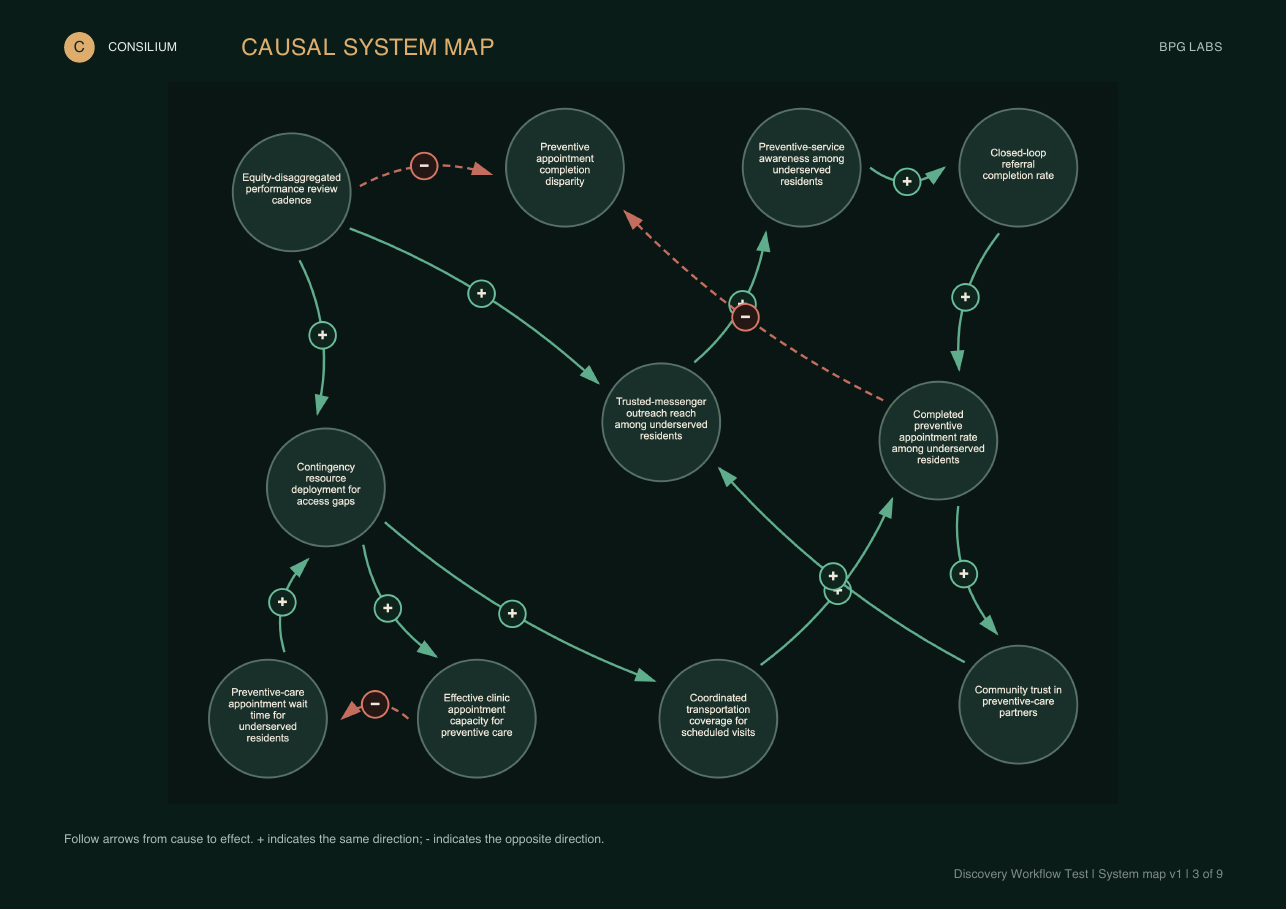
That picture should preserve disagreement rather than compress it into a reassuring summary.
Compare possible end states early.
Beginning with the end in mind does not mean fixing the solution prematurely.
It means asking early enough how the work might ultimately be owned, implemented, funded, governed, or sustained. Those questions often expose assumptions that would otherwise remain hidden until a pilot is already designed.
- 01Discover
- 02Map
- 03Decide
- 04Design
- 05Pilot
- 06Scale
Several end-state or business-model options can be considered without selecting one. The purpose is to improve today’s decision by understanding what different futures would require.
Turn uncertainty into explicit assumptions and risks.
Once the shared picture and end-state options are visible, the group can distinguish among evidence it already has, assumptions it is treating as facts, unresolved tensions requiring a decision, risks needing safeguards, and questions that can be answered only through practice.
This is more useful than adding another general recommendation. It shows what the next move needs to learn.
Choose the smallest responsible test.
The next test should reduce a meaningful uncertainty without committing the consortium to a solution it has not earned.
The result is not a guarantee of scale. It is a responsible next move that creates better evidence for the following decision.
Preserve ownership beyond the meeting.
A next-test plan is only useful if the reasoning and responsibilities survive the workshop.
Record why the test was chosen, which assumptions remain open, who owns each action, and when the group will review what it learns. If the work later returns to discovery, mapping, design, or business-model questions, that is not a failure to pass a stage gate. It is the process responding to evidence.
One decision. Two focused weeks. An owned next test.
A team can apply these principles itself. Outside support becomes useful when one consequential decision spans several organizations, the evidence and authority are distributed, and the sponsor can give the right people and materials focused attention for a short period.
BPG Labs offers a two-week Decision Sprint to define one decision, map stakeholders and evidence, compare end-state options, surface assumptions and risks, and agree an owned next-test plan with an executive readout. BPG Labs leads the process; Consilium may support the shared record when useful, but the engagement is not a software purchase.
See the two-week Decision Sprint